
The Fire Office (1680)
Event Date: 1680 Category: Company Foundings

Summary
The Fire Office, founded in 1680 by Nicholas Barbon, was the first successful fire‑insurance company in England. Created in direct response to the devastation of the Great Fire of London, it introduced the first standardized fire‑insurance policies and organized firefighting services. The Fire Office became the prototype for modern property‑insurance companies.
Background / Context
After the Great Fire of London in 1666 destroyed more than 13,000 buildings, the city faced enormous uninsured losses. Traditional relief systems — parish aid, charitable donations, and informal agreements — were overwhelmed. Demand for a reliable, contractual method of protecting property surged.
Nicholas Barbon, a physician‑turned‑entrepreneur and property developer, recognized both the need and the business opportunity. As London rebuilt under new fire‑resistant building codes, Barbon saw that insurance could accelerate reconstruction and stabilize the city’s commercial life.
What Happened
In 1680, Barbon and his partners founded the Insurance Office for Houses, commonly known as the Fire Office. It offered:
- standardized fire‑insurance policies
- coverage for brick and frame houses
- fixed annual premiums
- a dedicated firefighting brigade
- fire marks placed on insured buildings
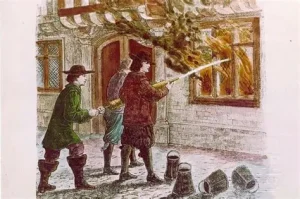
The Fire Office employed teams of watermen and equipment operators who responded to fires involving insured properties. Fire marks — metal plaques affixed to buildings — identified which insurer’s brigade was responsible for extinguishing a fire.
The company’s model proved commercially viable and quickly gained traction.
Claims Impact
The Fire Office introduced the first systematic approach to fire‑loss compensation:
- contractual claims obligations
- documented property valuations
- organized firefighting to reduce loss severity
- early forms of risk selection (brick vs. timber)
This structure dramatically improved the reliability of fire‑loss payments and reduced disputes. It also demonstrated that insurers could actively manage risk, not just price it.
Regulatory / Legal Impact
While not created by statute, the Fire Office influenced English legal and regulatory norms by:
- establishing enforceable fire‑insurance contracts
- creating standardized policy language
- shaping early judicial interpretations of property‑insurance obligations
- encouraging municipal authorities to coordinate with private brigades
Its practices laid groundwork for later fire‑insurance regulation and building‑code enforcement.
Market Impact
The Fire Office transformed the insurance marketplace by:
- proving that fire insurance could be profitable
- encouraging competitors (including the Friendly Society in 1684)
- introducing the concept of risk‑based pricing
- linking underwriting to physical risk‑mitigation (fire brigades)
- accelerating London’s reconstruction and economic recovery
It also helped establish London as the global center for property insurance.
Why It Mattered (Plain English)
The Fire Office is where modern property insurance truly begins. It turned the lessons of the Great Fire into a functioning business model that protected homeowners, stabilized commerce, and reduced the financial shock of urban fires.
It showed that insurers could do more than pay claims — they could prevent losses, organize emergency response, and shape safer cities. Every property insurer today traces part of its DNA back to Barbon’s experiment.
Related Entries
- 1666 — Great Fire of London — the disaster that created the demand for organized fire insurance and inspired Barbon’s model
- 1684 — The Friendly Society — the mutual competitor that expanded access to fire insurance beyond proprietary models
- 1680s–1690s — Fire Marks & Private Fire Brigades — the operational system of marks and brigades pioneered by the Fire Office
- 1688 — Lloyd’s Coffee House — the emerging underwriting marketplace that shaped early insurance culture
- 1752 — Philadelphia Contributionship — the first American fire insurer, adopting inspections, fire marks, and loss‑control practices modeled on the Fire Office
- 1774–1869 — The Rise of Insurance Regulation — the regulatory arc that later formalized fire‑insurance contracts and governance practices pioneered by the Fire Office
- Early English Fire‑Insurance Contracts (17th Century) (forthcoming) — the standardized policy forms and valuation practices introduced by Barbon’s Fire Office
Sources / Notes (Optional)
- Early charters of the Insurance Office for Houses
- London rebuilding records (post‑1666)
- Historical accounts of Nicholas Barbon
