
 💬 Why Difficulty Isn’t Just About Effort — It’s About Intent
Not all professional designations are built alike. Some are designed to onboard newcomers with foundational knowledge. Others demand years of experience, rigorous exams, or ongoing compliance. But here’s the deeper truth:
👉 Difficulty isn’t just about how hard something is. It’s about what it’s designed to do.
IDL profiles nearly a hundred credentialing organizations and over 200 insurance designations — each one indexed, ranked, and editorially framed to reveal its structural intent:
- 🪄 Some designations are built to welcome
- 🧱 Some are built to deepen
- 🧭 Some are built to elevate
- 🏛️ And a few are built to transform
That’s why we created the Designation Difficulty Index — not just as a visual guide, but as a way to decode the philosophical structure behind credentialing.
🔍 What the Index Actually Measures
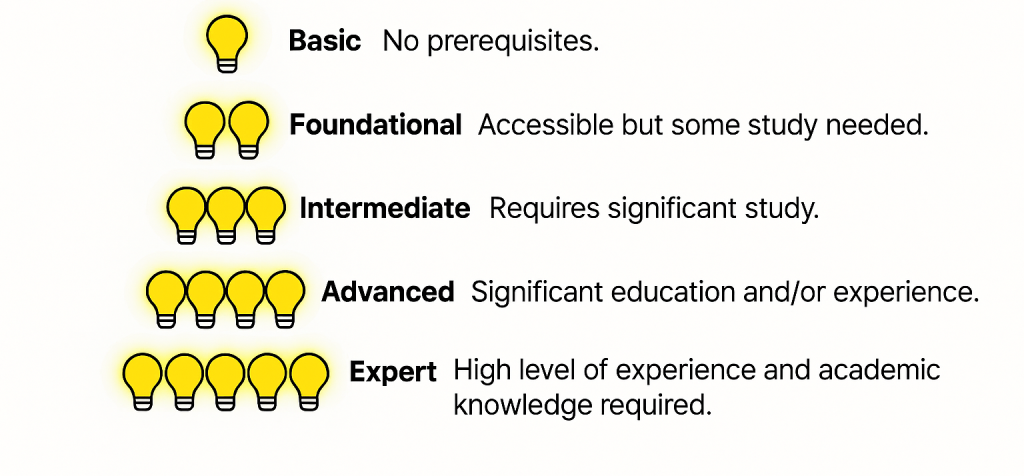
Each designation is assigned a difficulty level from Basic (💡) to Expert (💡💡💡💡💡). But this isn’t just about study hours or exam formats. It’s about intentional design — what the credential is meant to do for your career.
We evaluate difficulty based on:
- ⏳ Time commitment: Study hours, coursework, exam prep
- 🎓 Prerequisites: Experience, licensing, prior designations
- 📝 Exam rigor: Format, pass rates, retake policies
- 🔁 Maintenance: CE requirements, renewal cycles
- 🧠 Strategic depth: How much the designation shapes your trajectory
This isn’t a ranking of prestige. It’s a map of intensity — and purpose.
💡 The Five Levels of Credentialing Intent
💡 Level 1: Basic
Designed to welcome.
These designations are built for accessibility — onboarding newcomers, offering modular learning, and introducing core concepts without overwhelming complexity.
Typical traits:
- 🚪 No prerequisites
- 🕒 Short completion time
- 🧪 Low exam intensity
- 🧰 Practical, not strategic
Examples: AINS, CISR, TRIP, MLIS, CAWC
💡💡 Level 2: Foundational
Designed to build identity.
These credentials begin to shape professional roles. They’re structured, moderately rigorous, and often pursued by early-career professionals seeking credibility.
Typical traits:
- 📚 Some study required
- 🧮 Moderate exam structure
- 🪜 Limited prerequisites
- 🧭 Domain-specific depth
Examples: CIC, TRIP, APA
💡💡💡 Level 3: Intermediate
Designed to deepen expertise.
These designations demand layered understanding and strategic application. They’re often pursued by mid-career professionals expanding their scope.
Typical traits:
- 🧩 Multiple exams
- 🏫 Formal coursework
- 🧠 Strategic frameworks
- 🚀 Career-shaping potential
Examples: AAI, ARM, AU, ASLI
💡💡💡💡 Level 4: Advanced
Designed to elevate.
These credentials are structurally built for leadership, specialization, or high-stakes advisory roles. They often require experience, layered exams, and strategic positioning.
Typical traits:
- 📈 Significant study time
- 🧱 Layered prerequisites
- 🧑💼 Leadership or specialization focus
- 🛤️ Career trajectory impact
Examples: CRM, RPLU, CIC
💡💡💡💡💡 Level 5: Expert
Designed to transform.
These are the pinnacle designations — demanding mastery, ongoing compliance, and strategic influence. They often unlock access to executive, regulatory, or technical leadership roles.
Typical traits:
- 🎯 High prerequisites
- 🧮 Complex exams
- 🔄 Ongoing CE and ethics
- 🏛️ Industry-shaping impact
Examples: CPCU, FCAS, FSA, CFA, CLU
🧠 Why This Matters
Most providers don’t explain the intentional structure behind their designations. But we do.
Because when you’re investing time, money, and effort into credentialing, you deserve to know:
- 🧭 What the designation is built to do
- 🧱 How it fits into your career arc
- 🚀 Whether it’s a stepping stone or a strategic leap
The Designation Difficulty Index isn’t just a rating system. It’s a philosophical framework — one that helps you choose credentials with clarity, confidence, and purpose.
🔗 Explore the full catalog at Insurance Designation Lookup to see how each designation ranks — and why.
