
The Friendly Society (1684)
Event Date: 1684 Category: Company Foundings

Summary
The Friendly Society, founded in 1684, was one of the earliest mutual fire‑insurance organizations in England and a direct competitor to the Fire Office. Unlike proprietary insurers, it operated on a mutual model in which policyholders shared risk and contributed to losses collectively. The Society helped establish mutuality as a durable insurance structure and expanded access to fire insurance beyond London’s wealthiest property owners.
Background / Context
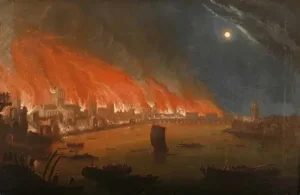
The Great Fire of London (1666) created enormous demand for reliable fire insurance. The Fire Office (1680) proved that fire insurance could be profitable and operationally viable, but its proprietary model limited participation to those who could afford its premiums.
At the same time, London’s rebuilding efforts brought together guilds, tradesmen, and middle‑class property owners who wanted protection but preferred a cooperative structure. Mutual aid traditions were already strong in English parishes and trade societies, making the idea of a mutual fire insurer both familiar and attractive.
What Happened
In 1684, a group of merchants and property owners founded the Friendly Society for the Mutual Insuring of Houses Against Loss by Fire. Its key features included:
- a mutual structure, with members sharing losses
- standardized fire‑insurance contracts
- lower premiums than proprietary insurers
- its own firefighting brigade
- fire marks to identify insured buildings
The Society’s firefighting teams operated similarly to those of the Fire Office, responding to fires involving buildings marked with the Society’s emblem. Its mutual model attracted a broad base of policyholders and helped normalize fire insurance as a standard household protection.
Claims Impact
The Friendly Society strengthened the emerging fire‑insurance system by:
- spreading losses across a larger pool of members
- reducing premium volatility
- improving claims reliability through collective funding
- reinforcing the link between insurance and organized firefighting
Its mutual structure demonstrated that fire insurance could serve not just wealthy merchants but also middle‑class homeowners and tradespeople.
Regulatory / Legal Impact
While not created by statute, the Friendly Society influenced English insurance practice by:
- legitimizing mutual insurance as a recognized business form
- encouraging courts to treat mutual contracts as enforceable agreements
- promoting clearer rules for member contributions and assessments
Its success helped pave the way for later mutual insurers in both fire and life insurance.
Market Impact
The Friendly Society intensified competition in the young fire‑insurance market. Its presence:
- pushed proprietary insurers to refine pricing and underwriting
- expanded the geographic reach of fire insurance
- increased public trust in insurance as a financial product
- helped establish London as the center of organized fire insurance
By the early 1700s, mutual and proprietary fire insurers coexisted, creating a more diverse and resilient market.
Why It Mattered (Plain English)
The Friendly Society proved that insurance didn’t have to be a top‑down business. It showed that ordinary property owners could pool their resources, share losses fairly, and protect themselves from catastrophic fire.
Its mutual model became a blueprint for later fire insurers, life insurers, and fraternal benefit societies. In many ways, it democratized insurance — turning it from a merchant’s tool into a community safeguard.
Related Entries
- 1666 — Great Fire of London — the catastrophe that created demand for organized fire insurance and mutual protection
- 1680 — The Fire Office — the first proprietary fire insurer and the Friendly Society’s primary early competitor
- 1680s–1690s — Fire Marks & Private Fire Brigades — the operational system of marks and brigades adopted by both the Fire Office and the Friendly Society
- 1688 — Lloyd’s Coffee House — the emerging underwriting marketplace that shaped early insurance culture
- 1706 — Amicable Society — an early mutual life‑assurance society reflecting the same cooperative principles
- 1752 — Philadelphia Contributionship — the first American fire insurer, adopting mutuality and fire‑mark traditions pioneered by the Friendly Society
- 1759 — Presbyterian Ministers Fund — an early American mutual benefit society echoing the Friendly Society’s cooperative model
- 1774–1869 — The Rise of Insurance Regulation — the regulatory arc that later formalized mutual governance and assessment practices
- Early English Mutual‑Aid Fire Clubs (17th–18th Centuries) (forthcoming) — the informal parish and guild‑based mutual‑aid groups that shaped the Friendly Society’s cooperative structure
Sources / Notes
- Early charters of the Friendly Society
- London fire‑insurance records (late 1600s)
- Historical accounts of mutual aid societies
