
The Great Fire of London (1666)
Event Date: September 2–6, 1666 Category: Disasters & Claims
Summary
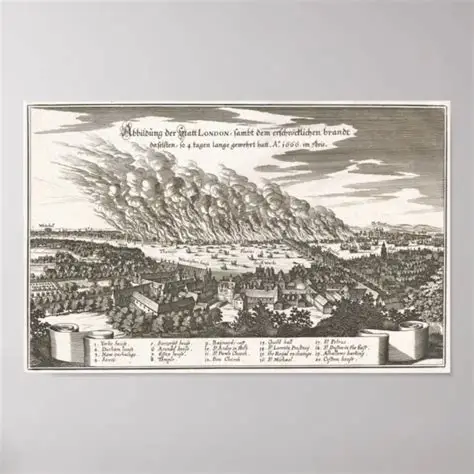
The Great Fire of London burned for four days in September 1666, destroying more than 13,000 buildings and reshaping the physical and economic landscape of the city. The scale of destruction exposed the limitations of informal fire‑loss arrangements and directly accelerated the creation of organized fire insurance in England. The event became the catalyst for modern property insurance.
Background / Context
Seventeenth‑century London was a dense, wooden city with narrow streets, open hearths, and highly combustible construction. Fire was a constant threat, but there was no formal fire insurance system. Losses were typically handled through parish relief, charitable donations, or ad hoc agreements among merchants.
The city had already suffered major catastrophes — including the 1665 plague — and its infrastructure was fragile. Building codes were minimal, firefighting equipment was primitive, and municipal coordination was weak. A major urban fire was not just possible; it was inevitable.
What Happened
In the early hours of September 2, 1666, a fire began in Thomas Farriner’s bakery on Pudding Lane. Strong winds, dry conditions, and tightly packed timber buildings allowed the flames to spread rapidly. Over four days, the fire consumed:
- roughly 13,200 houses
- 87 parish churches
- St. Paul’s Cathedral
- most civic buildings
- warehouses, markets, and commercial districts
Tens of thousands were displaced. Although the official death toll was low, modern historians believe many deaths went unrecorded due to intense heat and incomplete documentation.
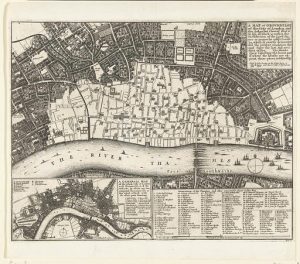
The fire finally stopped after winds died down and firebreaks were created — some by demolition, others by natural gaps in the city’s layout.
Samuel Pepys — primary eyewitness
“I saw the fire grow; and as it grew darker, appeared more and more, and in corners and upon steeples, and between churches and houses, as far as we could see.” — Samuel Pepys, Diary, September 2, 1666
John Evelyn — the moral and civic dimension
“The conflagration was so universal, and the people so astonished, that from the beginning… nobody seemed to know what to do.” — John Evelyn, Diary, September 1666
Claims Impact
The Great Fire revealed the complete absence of a structured mechanism for compensating property losses. Key impacts included:
- widespread uninsured losses among homeowners and merchants
- insolvency for many businesses
- increased demand for reliable, contractual fire protection
- emergence of early fire insurance schemes within months
The disaster directly led to the founding of the Fire Office (1680) and the Friendly Society (1684) — the first true fire insurers in England. These companies introduced fire marks, organized firefighting brigades, and standardized property‑insurance contracts.
Regulatory / Legal Impact
The fire triggered sweeping regulatory reforms, including:
- the Rebuilding Act of 1667, which mandated brick and stone construction
- new street‑widening and urban‑planning rules
- early building‑code enforcement
- clearer property‑record systems to support future insurance contracts
These reforms created the legal and physical environment necessary for fire insurance to function at scale.
Market Impact
The fire transformed the insurance marketplace by:
- creating immediate demand for fire insurance
- encouraging capital formation for new fire‑insurance ventures
- establishing the link between urban density and catastrophic loss potential
- laying groundwork for actuarial thinking about fire risk
- accelerating London’s rise as a global insurance center
Within a generation, fire insurance became a standard commercial product, and insurers began forming dedicated firefighting brigades — a precursor to municipal fire services.
Why It Mattered (Plain English)
The Great Fire of London is the moment when property insurance became necessary rather than optional. It showed that a single urban catastrophe could wipe out entire neighborhoods, businesses, and fortunes — and that informal relief systems were nowhere near adequate.
The fire forced London to rebuild smarter, safer, and with a new understanding of risk. More importantly, it created the conditions for the world’s first fire‑insurance companies, which in turn shaped modern property insurance, building codes, and urban risk management.
In short: this disaster created the market that property insurers still operate in today.
Related Entries
- 1693 — Halley’s Life Table — early mortality science emerging in the same post‑catastrophe intellectual climate
- 1680 — The Fire Office — the first successful fire‑insurance company, founded directly in response to the Great Fire
- 1684 — The Friendly Society — early mutual fire insurer expanding access to fire protection after the disaster
- 1680s–1690s — Fire Marks & Private Fire Brigades — the operational firefighting systems created by early insurers to prevent another catastrophe
- 1688 — Lloyd’s Coffee House — the emerging underwriting hub shaped by London’s post‑fire commercial reconstruction
- 1752 — Philadelphia Contributionship — the first American fire insurer, adopting inspection and prevention practices inspired by London’s post‑1666 reforms
- 1774–1869 — The Rise of Insurance Regulation — the regulatory arc that formalized building codes, fire‑insurance contracts, and municipal coordination
- 1871 — The Great Chicago Fire — the 19th‑century urban catastrophe often compared to the Great Fire of London for its impact on insurance and building codes
- 1872 — The Great Boston Fire — another major urban conflagration that reshaped underwriting and municipal fire protection
- 1667 — The Rebuilding Act (forthcoming) — the post‑fire legislation mandating brick construction and urban‑planning reforms that enabled modern fire insurance
Sources / Notes
- London Gazette accounts (1666)
- Rebuilding Act of 1667
- Early fire‑insurance company charters
- Additional Literary & Biographical References
- Samuel Pepys, Diary — Pepys gives the most famous firsthand account of the fire, including the moment he climbed the Tower of London to watch the city burn.
- John Evelyn, Diary — Evelyn’s entries complement Pepys with detailed descriptions of destruction and public response.
- T.F. Reddaway, The Rebuilding of London After the Great Fire — a foundational historical study.
- Adrian Tinniswood, By Permission of Heaven: The Story of the Great Fire of London — modern narrative history.
- Contemporary broadsides and London Gazette reports — primary sources documenting the fire’s spread and aftermath.
